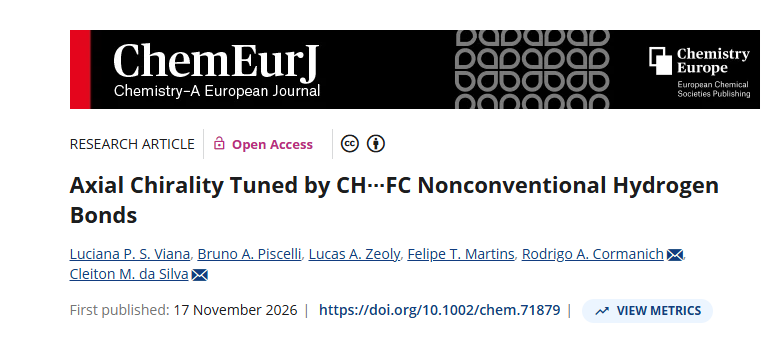
We are pleased to announce the publication of our latest research article, “Axial Chirality Tuned by CH···FC Nonconventional Hydrogen Bonds”, in Chemistry – A European Journal.
In this study, we investigate the origin of axial chirality in fluorinated anilide derivatives, focusing on the role of nonconventional intramolecular hydrogen bonds between C–H and C–F groups (CH···FC interactions) and their interplay with stereoelectronic effects. Axial chirality arises when molecular rotation around a bond becomes sufficiently restricted, allowing distinct conformations to behave as stereochemically distinguishable structures. Understanding the factors governing this rotational restriction is particularly important in organofluorine chemistry, where weak noncovalent interactions can play a significant role in determining molecular structure and properties.
Combining variable-temperature 1H NMR spectroscopy, X-ray crystallography, and quantum chemical calculations, we demonstrate how CH···FC interactions contribute to the stabilization of molecular conformations and influence rotational barriers around the aryl–C–N bond. Our computational investigation, supported by Natural Bond Orbital (NBO) analysis, further reveals that these interactions act cooperatively with orbital delocalization effects, particularly nN → πCO and nN → πAr interactions. The balance between these contributions, together with aromatic substituent effects, determines the rotational barriers and ultimately tunes the axial chirality of these compounds.
These findings provide new insights into the interplay between weak intramolecular interactions and stereoelectronic effects, highlighting how subtle molecular interactions can have important consequences for conformational stability and molecular chirality.
https://chemistry-europe.onlinelibrary.wiley.com/doi/full/10.1002/chem.71879