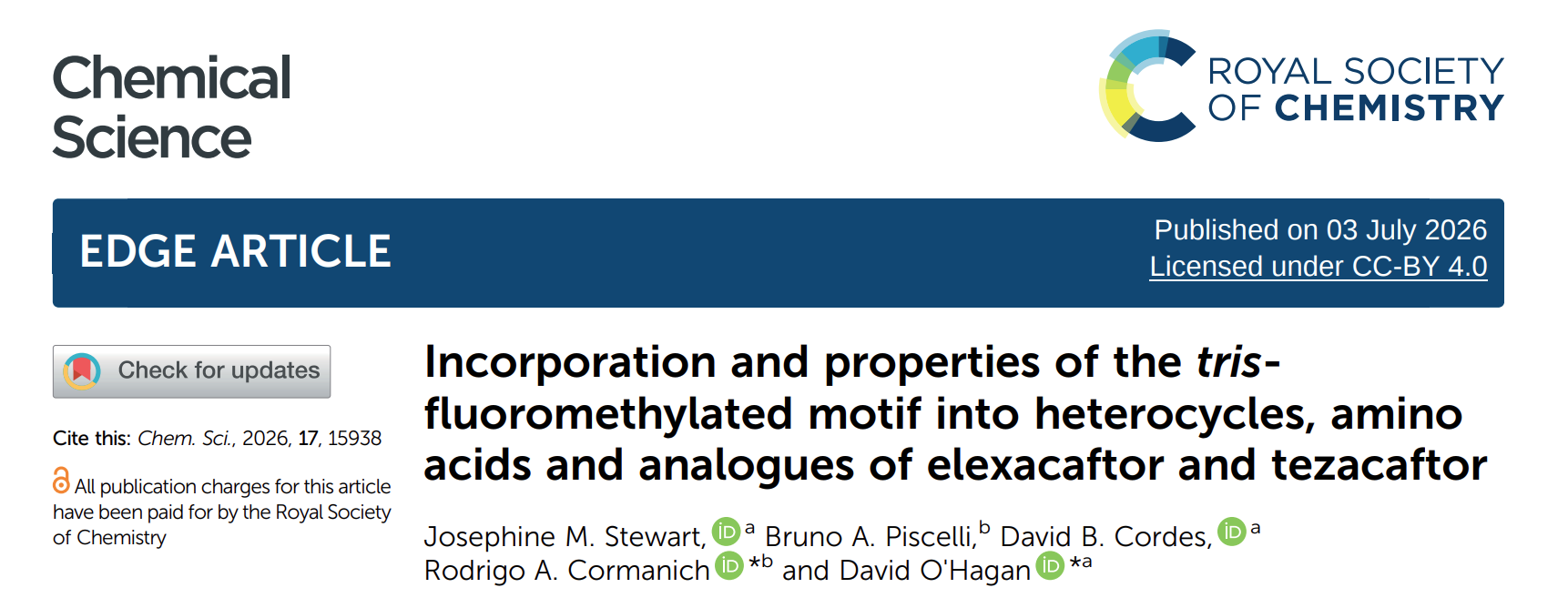
Our group has recently published a new study in Chemical Science (2026) in collaboration with Prof. David O’Hagan, from the University of St Andrews. The work explores the incorporation of the tris-fluoromethylated motif (–CF₂H)₃C– into heterocycles, amino acids, and analogues of the high-profile pharmaceuticals elexacaftor and tezacaftor, investigating how this fluorinated motif influences molecular polarity,…
Category: post
We are pleased to share our latest publication in Physical Chemistry Chemical Physics: Special congratulations to Bruno Piscelli and Caio Nascimento for the paper. This publication represents another step toward understanding the stereoelectronic effects that govern the chemistry of fluorinated strained molecules and their potential applications in organic synthesis.In this work, we investigate how progressive…
I am very happy to share our new collaborative work with Stephan P. A. Sauer. I would also like to congratulate Elif Kucukefe for the tremendous hard work and dedication that made this study possible. Our new paper has now been published in Physical Chemistry Chemical Physics: “Benchmarking B3LYP, PBE0 and M06L for nuclear spin-spin…
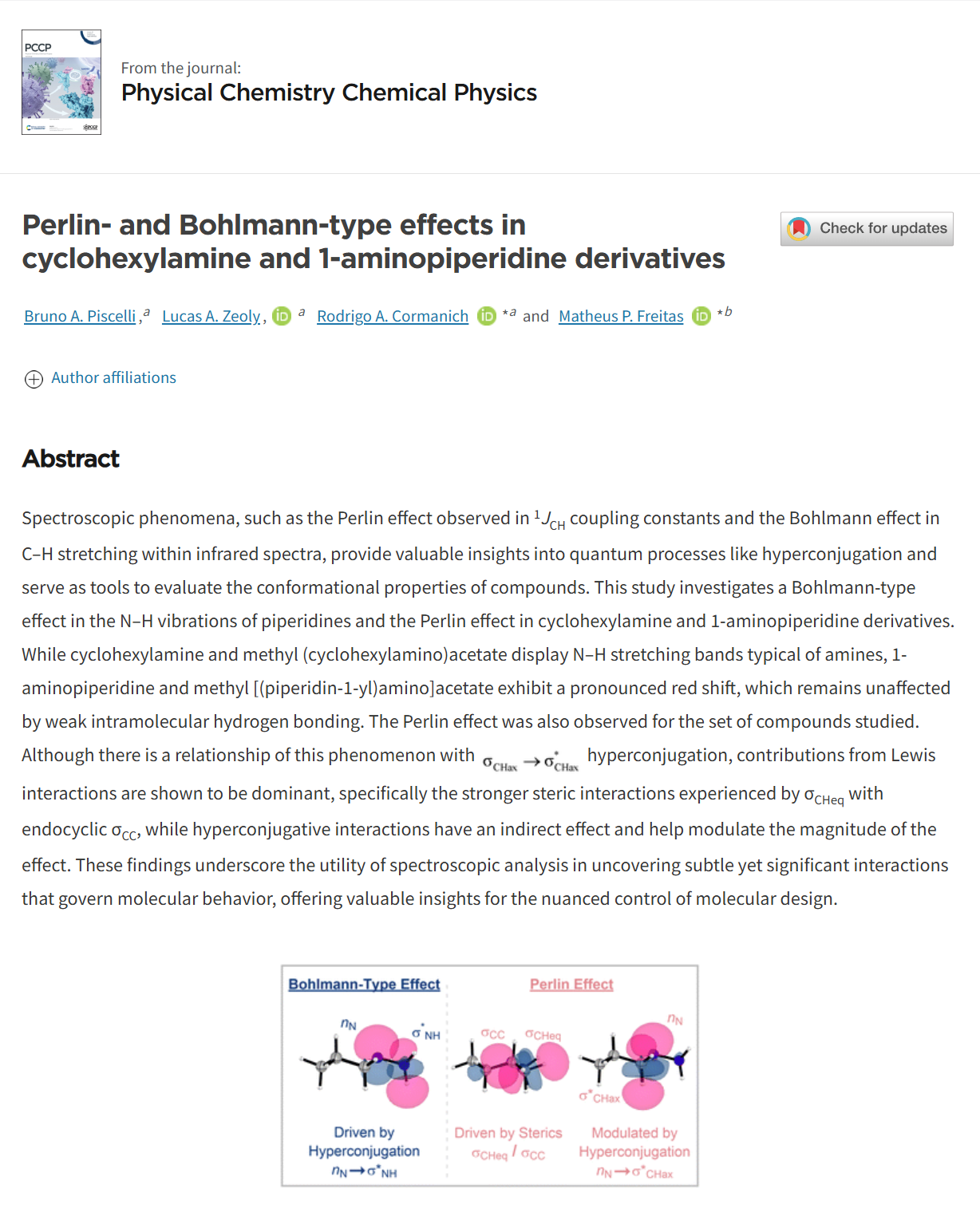
We are pleased to share our new publication in Physical Chemistry Chemical Physics titled “Perlin- and Bohlmann-type effects in cyclohexylamine and 1-aminopiperidine derivatives.” In this work, we investigate how classical stereoelectronic effects, namely the Perlin and Bohlmann effects, manifest in cyclohexylamine and 1-aminopiperidine derivatives. By analyzing spectroscopic data, we explore the electronic interactions responsible for…
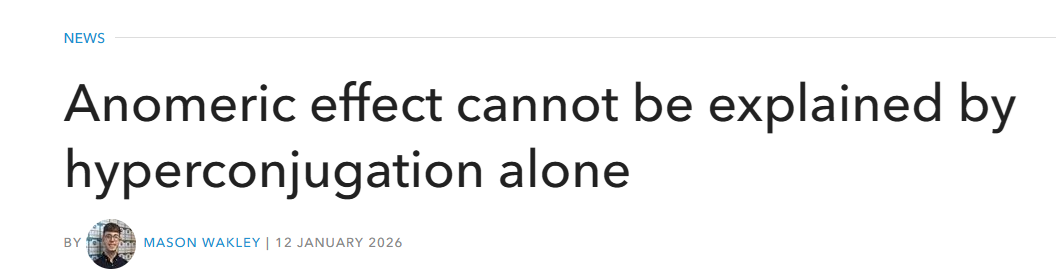
A recent article in Chemistry World revisits one of the most discussed stereoelectronic phenomena in organic chemistry: the anomeric effect. Instead of reinforcing the traditional, single-cause explanation based on hyperconjugation, the piece reports new computational evidence showing that the effect emerges from a balance of multiple contributors. Based on a detailed study led by Igor…
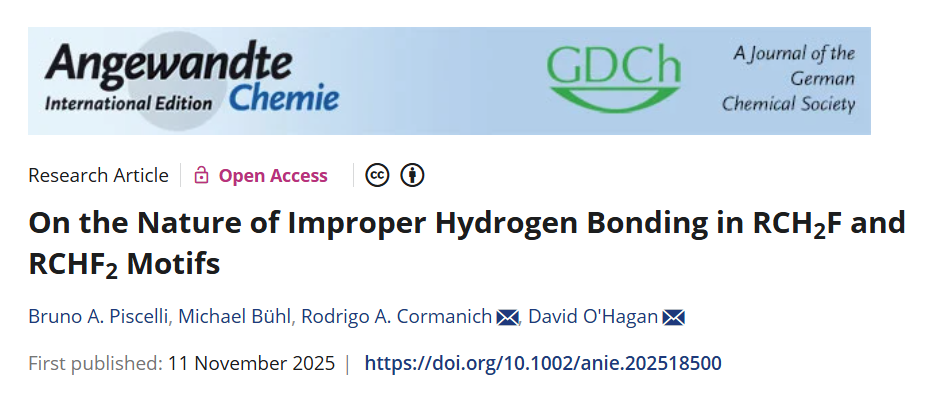
New paper in Angewandte Chemie: Improper hydrogen bonding in RCH₂F and RCHF₂ motifs Congratulations to Bruno A. Piscelli for his new paper published in Angewandte Chemie! This paper was done in collaboration with David O’Hagan and Michael Bühl from the University of St Andrews. In this work, we use high-level quantum-chemical calculations to understand how…
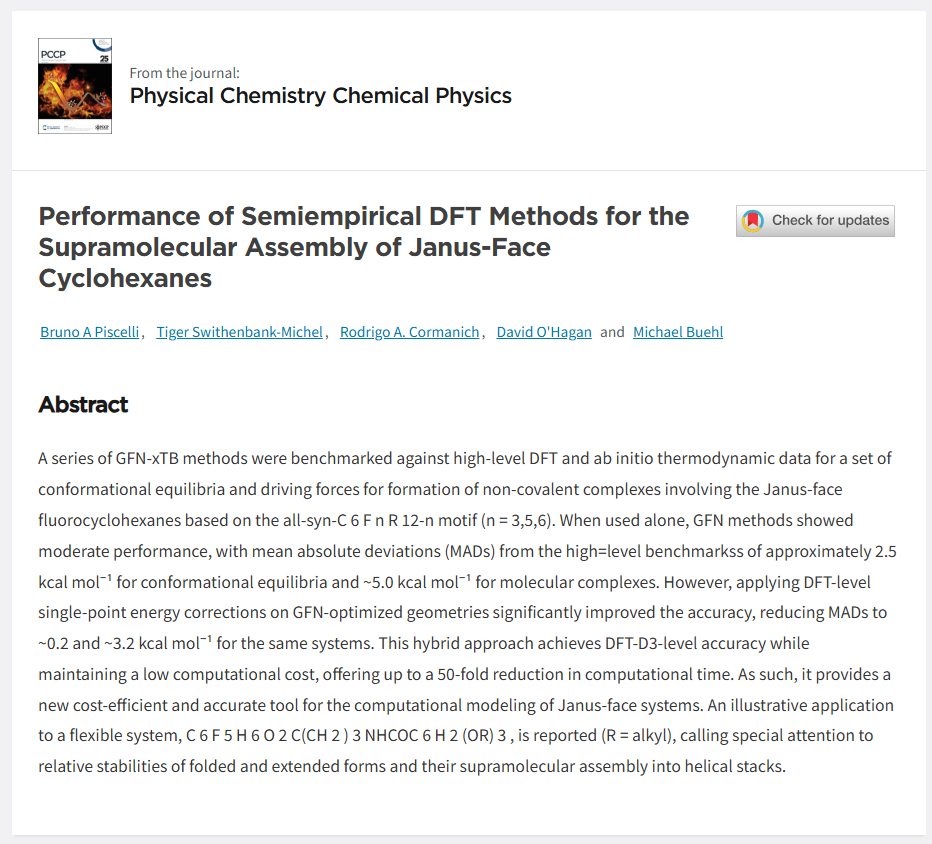
Our new article, “Performance of Semiempirical DFT Methods for the Supramolecular Assembly of Janus-Face Cyclohexanes,” is out in Physical Chemistry Chemical Physics. We benchmark GFN-xTB against high-level DFT/ab initio for conformational equilibria and supramolecular stacking, and show that DFT single-point corrections on GFN-optimized geometries reach near-DFT-D3 accuracy at much lower cost. This enables faster, reliable…
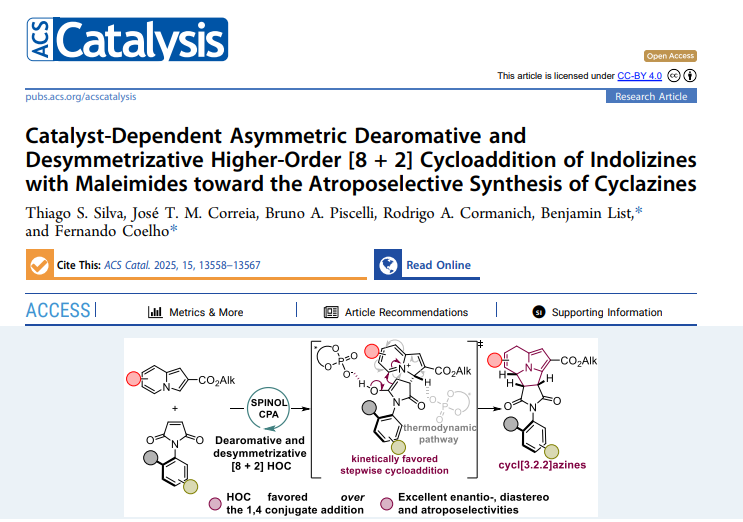
We are pleased to share that our new open‑access article, “Catalyst‑Dependent Asymmetric Dearomative and Desymmetrizing Higher‑Order [8 + 2] Cycloaddition of Indolizines with Maleimides toward the Atroposelective Synthesis of Cyclazines,” has just been published in ACS Catalysis (22 July 2025). The study is the culmination of Thiago S. Silva’s experimental work—carried out as part of his PhD stay in Prof. Benjamin List’s laboratory—and Bruno A. Piscelli’s in‑depth…
We are pleased to share our latest collaborative work with Professor Fernando Coelho’s group, now published in Organic & Biomolecular Chemistry: “An asymmetric and theoretical approach to the Morita–Baylis–Hillman reaction using vinyl-1,2,4-oxadiazoles as nucleophiles”† Thaynan A. B. Chagas, Bruno A. Piscelli, Hugo Santos, Sâmia R. Lima, Rodrigo A. Cormanich,* Fábio S. Fernandes,* and Fernando Coelho*https://doi.org/10.1039/d5ob00540j…
Excited to share our latest collaborative work with the Jurberg group: “Visible Light-Mediated Preparation of a Key Intermediate Employed in the Synthesis of Zolpidem and Several Analogs” In this study, we developed a visible light-driven C3-alkylation protocol for imidazo[1,2-a]pyrimidines and imidazo[1,2-a]pyridines using aryldiazoacetates. This strategy provides efficient access to known and novel analogs of a…